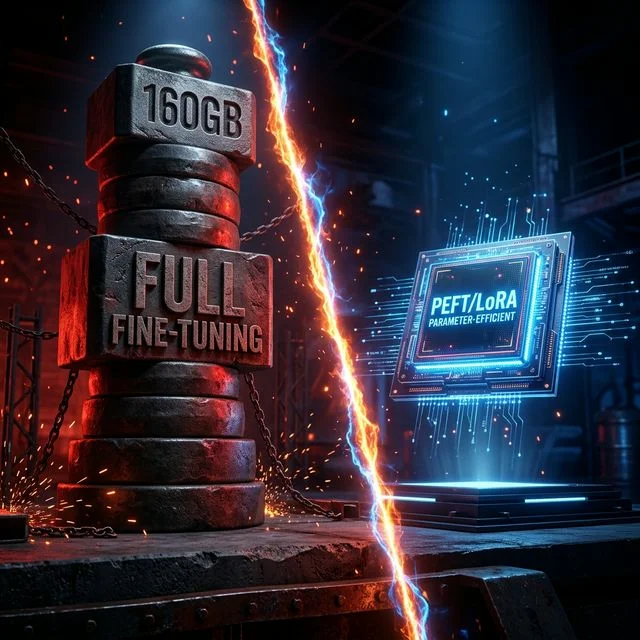
The pursuit of creating bespoke, highly specialized AI models locally has dominated the modern developer landscape. Yet, when confronted with the reality of altering a model's foundational knowledge, developers are immediately faced with a brutal hardware limitation. The debate essentially splits into two core methodologies: Full Fine-Tuning and Parameter-Efficient Fine-Tuning (PEFT).
In this deep, intensive Reality Check, we will explore the extreme architectural differences between these two methods, unpack why VRAM dictates your entire strategy, and explain why the 16GB RTX 5070 Ti represents a very different value proposition compared to an RTX 5090 depending on your chosen path.
Understanding Full Fine-Tuning
When a massive corporation like Meta trains a base model like Llama 3 8B, they execute what is known as "pre-training." They feed the model raw internet data, utilizing massive server clusters operating in tandem.
Full Fine-Tuning attempts to mimic this process on a smaller scale. You unfreeze all 8 Billion parameters. When you feed the model your specialized dataset (for instance, medical literature or unique programming syntaxes), the training algorithm calculates the error (Loss) and mathematically updates every single one of those 8 Billion parameters simultaneously.
The 160GB Problem
This sounds excellent in theory—your model becomes profoundly adapted to your specific use case. The reality is mathematically devastating for consumer hardware.
To update an 8B model via Full Fine-Tuning, your GPU must store:
- The baseline model weights in full precision (~16GB).
- The gradient state for every parameter calculating the math updates (~16GB to 32GB).
- The AdamW Optimizer states for every single parameter (the momentum and variance needed to update correctly) (~32GB to 64GB).
- The actual forward and backward pass activation computations (massive, depending on sequence length).
To Full Fine-Tune an 8B model comfortably, you need > 160GB of VRAM.
The flagship NVIDIA RTX 5090 possesses 32GB of VRAM. A legendary dual-RTX 3090 workstation boasts 48GB. Even if you string together four RTX 4090s via riser cables, you still fall desperately short. This method physically cannot be performed on a local consumer workstation; it requires renting massive cloud arrays of NVIDIA A100 or H100 GPUs at extreme API hourly costs.
The Savior: PEFT and LoRA
The solution to the 160GB VRAM disaster lies in Parameter-Efficient Fine-Tuning (PEFT). The most incredibly successful subtype of PEFT is known as LoRA (Low-Rank Adaptation).
LoRA fundamentally challenges the idea that every parameter needs to be updated. Instead of unfreezing the 8 Billion baseline weights, LoRA locks them completely. It then injects a tiny, ultra-thin "adapter" matrix (representing just an infinitesimally small fraction of the model's total size) alongside the frozen weights.
When your dataset teaches the model, the mathematical updates—the gradients, the optimizer momentum, the heavy calculation—only interact with those tiny adapter matrices.
The Scale of Compression
By locking the gargantuan foundation and only training the LoRA adapter, the math changes drastically:
- Frozen Weights: Can be quantized (compressed) using methods like QLoRA from 16-bit down to 4-bit, dropping the base model size from 16GB to around 6GB.
- Adapter Update Math: Instead of calculating updates for 8 Billion parameters, LoRA might only update 10 to 40 Million parameters.
The result? The entire training loop drops from 160GB down to under 12GB of VRAM.
Suddenly, the highly affordable NVIDIA RTX 3060 12GB or an AMD RX 9070 becomes a legitimate workstation capable of training cutting-edge AI software.
Do I Need a Monstrous GPU for PEFT?
If QLoRA drops VRAM requirements so drastically, why do researchers still purchase the $1,999 RTX 5090?
Because the "12GB VRAM threshold" is only applicable for low-parameter models (8B) utilizing extremely short context lengths.
If you wish to train an AI on complex, long-form logic puzzles, massive GitHub repositories, or multi-page character dialogue scripts, your sequence length must increase from a paltry 512 tokens to massive 8K or 32K context bounds. Additionally, increasing your Batch Size (how many files the AI reads simultaneously to stabilize its learning algorithms) multiplies VRAM consumption exponentially.
Furthermore, if you graduate from small 8B models up to "Smart" models like Llama 3.3 70B, you'll find that even an aggressively quantized 4-bit 70B model requires nearly 45GB of VRAM simply to load—let alone leave overhead for LoRA gradients. If you intend to fine-tune a 70B model, a dual RTX 4090 setup or a monstrous Mac Studio M4 Max with 128GB of Unified Memory becomes your absolute minimum baseline.
Conclusion
Full Fine-Tuning remains the domain of enterprise mega-corps and data centers. It is phenomenally expensive and wholly unsuited for local setups.
By contrast, PEFT structures like LoRA, incredibly accelerated by frameworks like Unsloth, put staggering power into the hands of the prosumer. A carefully assembled Mid-Range Build centered around 16GB VRAM cards like the RTX 5070 Ti represents the definitive sweet spot. It provides enough VRAM to comfortable execute deep sequence-length QLoRA runs on 8B datasets while delivering the incredibly fast throughput afforded by Blackwell architectures.
Always check our GPU Comparison matrix to benchmark VRAM vs pricing before pulling the trigger on a training rig!
About the Author: Justin Murray
AI Computer Guide Founder, has over a decade of AI and computer hardware experience. From leading the cryptocurrency mining hardware rush to repairing personal and commercial computer hardware, Justin has always had a passion for sharing knowledge and the cutting edge.